How Facebook's Algorithm Ranks Your Feed: Signals, Predictions & Controls
Meta's algorithm determines which posts appear in your feed and in what order. Learn the four ranking stages, behavioral predictions, documented signals, and user controls that influence your content visibility — explained from Meta's official transparency sources.


Contents 7 sections
- 1 The Four Ranking Stages According to Meta
- 2 Behavioral Predictions Calculated by the Algorithm
- 3 Documented Ranking Factors from Meta
- 4 Political Content: Meta's Evolving Approach
- 5 User Controls Over Your Facebook Feed
- 6 What These Mechanics Mean for Your Publishing Strategy
- 7 Frequently Asked Questions
The Facebook algorithm decides, on every visit, which of your publications appear in your followers' feeds - and in what order. Yet the mechanics remain largely unknown, even among creators and brands who post daily. Result: carefully crafted content disappears into the void, while others capture disproportionate attention.
The stakes are far from cosmetic. The organic reach of a Page or personal account depends directly on the signals this algorithm captures from each post. Understanding these signals means understanding why some posts generate genuine interactions while others don't.
This article draws on Meta's transparency resources to describe the four ranking stages, calculated predictions, documented factors, and controls you can enable. No speculation: only what Meta officially documents.
The Four Ranking Stages According to Meta
Meta describes Facebook's algorithm in four distinct phases, presented publicly in its documentation on ranking and content. Understanding these phases shows exactly where each signal enters the process.
1. Inventory of Available Posts
At each feed load, the system assembles all potentially displayable posts: content from your friends, Pages you follow, and groups you participate in - excluding content flagged as violating community standards. Meta also notes that the feed combines this "connected" content (from your connections) with recommended content from accounts you don't yet follow.
2. Signal Collection
Once this inventory is built, the system collects ranking signals. Meta acknowledges using multiple machine learning models and many variables to evaluate each post. These signals range from interaction history with an author to post type, content freshness, and explicit user feedback. A lightweight model then selects approximately 500 of the most relevant posts.
3. Behavioral Predictions
From the collected signals, the AI system calculates predictions about which content you'll find most relevant and useful. These probabilities are calculated individually for each user and each post, taking into account their preferences and personal history.
4. Relevance Score and Diversity Rules
All predictions generate a relevance score. Meta notes that approximately 500 posts are scored at each feed load, and diversity rules then apply - to prevent, for example, the feed from being dominated by a single content type or author. Meta's stated goal is to display posts that will deliver the most value to users.
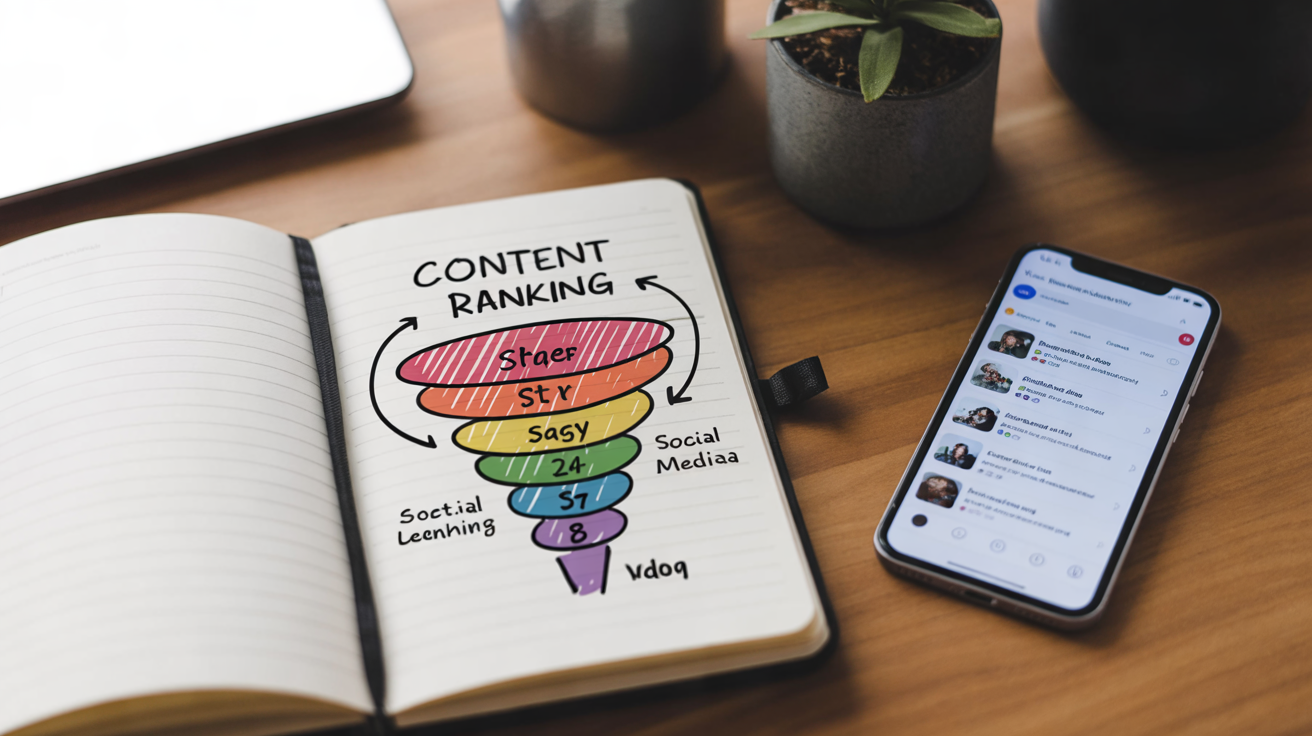
This funnel architecture - inventory, signals, predictions, score - mirrors the logic found in other recommendation systems, like the Instagram algorithm or other social platforms. Each stage filters and ranks, until producing the personalized feed you see.
Behavioral Predictions Calculated by the Algorithm
The Facebook algorithm doesn't just measure what happened: it anticipates what you're likely to do with each post. Meta lists several prediction categories in its official documentation on ranking.
- Likelihood of clicking on part of the post: whether the post itself, a photo it contains, or the comments section. Meta groups several related models under this category.
- Likelihood of engaging: overall engagement - liking, reacting, or commenting on a post.
- Likelihood of watching a video and predicted watch time: Meta accounts not only for watching a video, but also how long you're likely to spend on it.
- Likelihood of sharing the post: including prediction of how many additional times the post will be shared if you share it yourself.
- Likelihood of reporting the post: this signal is used to reduce distribution of potentially problematic content.
- Likelihood of wanting to see more or less from this author: the system anticipates whether you'll want to follow more closely or disengage from the source.
These predictions explain why a post generating genuine responses - substantive comments, organic shares - typically gets better distribution than one that racks up simple clicks. The algorithm seeks to detect real interest, not mechanical interaction.
This predictive logic has direct implications for your editorial strategy. Posts that invite natural reactions (a genuine question, video content watched to completion) activate more of these positive predictions. To explore concrete practices that trigger these mechanics, see our guide on Facebook engagement strategies that make a difference.
Documented Ranking Factors from Meta
Beyond predictions, Meta identifies several ranking factors that feed the models. They split into two categories: primary signals and secondary signals.
Primary Signals
- Past interactions with the author: if you've regularly commented on or reacted to a Page's or person's posts, their new content gets a stronger score in your feed.
- Post type: video, link, image, text only. The algorithm adapts its predictions based on format, without any format being universally privileged - it's the user's historical engagement with that format that matters.
- Volume of reactions, comments, and shares: a popularity signal, but weighted by relevance to the user in question.
- Freshness: recent posts are favored at equivalent scores.
- Explicit user feedback: signals like "Hide," "Not interested," or "Report" directly influence future ranking for that user.
Secondary Signals
- Device type used (mobile or desktop).
- Internet connection quality.
- Post language.
- User geographic location.
"We personalize each Feed for our more than 2 billion users by using state-of-the-art machine learning systems to rank content." - Meta, documentation on ranking and content.
An important note on external links: Meta doesn't document a penalty on posts containing links to third-party sites. Claiming otherwise would be unsupported speculation. What is documented is that the ratio of clicks on external links compared to how many times those links were shown counts among the signals considered.
These factors paint a clear picture: publishing regularity, ability to spark authentic interactions, and consistency with audience habits are the best-documented levers. To dive deeper into growing your audience, the article on how to get more Facebook followers usefully complements this overview.
Political Content: Meta's Evolving Approach
Since January 2025, Meta has announced and progressively rolled out a new approach to political content, documented on its dedicated political content page. After several years of voluntarily reducing distribution of civic content, Meta now treats political content - defined as posts potentially related to laws, elections, or societal issues - much like any other content type on its platforms. This means Meta can also recommend political content from accounts you don't yet follow.
A specific setting, "Political Content," is available in Content Preferences: it lets users who want to see less political content in their feed. Users who don't adjust this setting will see political content treated by the same relevance signals as other content.
Additionally, content flagged for misinformation or policy violations receives explicit distribution-reduction rules documented by Meta on its page on reducing problematic content distribution. In the United States, Meta replaced its third-party fact-checking program in 2025 with Community Notes: community-added notes provide context but don't automatically trigger distribution reduction. Outside the U.S., when a fact-checking partner rates content as false, Meta may reduce its feed distribution. Content authenticity - freedom from manipulation, misleading headlines, or coordinated inauthentic behavior - remains a signal factored into scoring.
User Controls Over Your Facebook Feed
The Facebook algorithm isn't a closed system. Meta provides several controls letting users adjust what they see - and these adjustments feed back into ranking signals. These mechanisms are detailed in Meta's documentation on controlling what you see in your news feed.
Favorites
Facebook lets you add people and Pages to a Favorites list. Their posts then get priority in your main feed and you'll see their most recent content first. Meta confirms that up to 30 friends and Pages can be added to Favorites. Note: no notification is sent to accounts when you add or remove them from this list.
Chronological Feed via the Feeds Tab
The "Feeds" tab gives you access to the most recent posts from people, Pages, groups, and Favorites you follow, sorted newest to oldest (with ads). This mode isn't persistent: it doesn't replace the default algorithmic feed on the Home tab and must be activated manually each session.
Individual Controls on Each Post
For each post visible in your feed, several actions are available via the context menu:
- Hide: signals that you don't want to see this type of post again.
- Interested / Not interested: temporarily boosts or reduces the ranking score of this post and similar content.
- Snooze: temporarily suspends posts from an account, Page, or group for 30 days without unfollowing.
- Unfollow: stops receiving a person's or Page's posts in your feed, while remaining connected or subscribed.
- Report: escalates a post to Meta's moderation teams.
- "Why am I seeing this?": displays the reasons the algorithm documented for ranking this content in your feed.
Each action sends an explicit signal to the algorithm, which adjusts future predictions for that user. Meta also details feed personalization options in its blog post on new ways to customize your Facebook feed.
What These Mechanics Mean for Your Publishing Strategy
Now that the mechanics are laid out, what practices follow logically? Here's what the documented signals suggest concretely.
Prioritize Posts That Invite Genuine Response
The algorithm predicts the likelihood of engagement. A genuine question posed to your community, a topic that naturally divides opinion, content that deserves a comment - that's what activates positive predictions. Avoid engagement calls framed as mechanical demands ("Tell us in the comments!") in favor of content that makes reactions feel natural.
Maintain Publishing Regularity
Freshness is an explicit signal. Regular presence ensures your posts frequently enter the scoring cycle, with structural advantage over accounts posting sporadically.
Invest in Video Watched in Depth
Among Meta's listed predictions, video watch time is a documented quality signal. Videos with strong pacing and compelling openings in the first seconds maximize this likelihood. Meta accounts not just for watching a video but for how long users spend on it - though Meta doesn't publish a precise numerical threshold.
Build Regular Relationship with Your Audience
Past interactions with the author are a primary factor. The more your audience has engaged with your previous posts, the more your new content benefits from a favorable score. It's a virtuous circle built over time, not in a single post.
To strengthen the social proof of your Page and anchor this virtuous circle, some creators and brands choose to buy likes on Facebook posts to solidify initial credibility. This approach doesn't guarantee direct effect on algorithmic ranking - Meta documents no causal link between purchased like volume and relevance score - but it can strengthen the perceived credibility of a Page getting started.
Ready to boost your presence?
Place your order in 2 minutes, drip-feed delivery, credible profiles, retention guarantee.
Frequently Asked Questions
Can you disable the Facebook algorithm and see your feed in chronological order?
There's no permanent way to disable Facebook's algorithm. The "Feeds" tab offers chronological display of posts from your friends, Pages, and groups sorted newest to oldest (with ads), but this mode must be activated manually each session - it doesn't replace the default algorithmic feed on the Home tab. The Favorites function, however, lets you prioritize posts from people and Pages you choose, seeing their most recent content first.
What types of posts are favored by Facebook's algorithm?
Meta doesn't document a universally favored format. The algorithm predicts each user's likelihood of engaging with each content type based on their history. Videos watched in depth, posts generating substantive comments, and content shared beyond the author's network activate multiple positive predictions simultaneously, tending to improve their relevance score.
Are external links penalized by Facebook's algorithm?
Meta documents no systematic penalty on posts containing external links. What is documented is that click behavior on external links (relative to how many times those links are shown) counts among the signals considered. Claiming an automatic outbound link penalty would be unsupported by official sources.
How does Facebook decide what I see in my news feed?
At each load, the Facebook algorithm collects signals on available posts, calculates individual behavioral predictions (likelihood of reaction, watch, share, engagement) and generates a relevance score for each piece of content. Approximately 500 posts are scored per session according to Meta, and diversity rules apply before final display, to prevent over-representation of a single author or format.
Is everyone's Facebook feed the same?
No. The feed is fully personalized: each user sees a different ranking calculated from their past interactions, explicit feedback (Hide, Favorites, Unfollow), and consumption habits. Two followers of the same Page therefore see its posts at different times and in different orders depending on their respective engagement profiles.
Facebook's algorithm rests on documented, precise, and (partly) modifiable logic. Four stages, many signals, behavioral predictions, and user controls: that's what Meta makes public. What you do with it depends on your ability to produce content that sparks genuine interactions, maintain regular presence, and leverage available settings. If you're looking to strengthen your Facebook Page presence in English-speaking markets, also explore the option to buy Facebook fans to consolidate your initial audience base.
Julie Faure
Senior Writer — Social Media
✍️ Professional writer. Web content, SEO & brand content. Specialized in social media & digital marketing.
Julie supports creators, brands and entrepreneurs on their social media strategies and online visibility. She shares hands-on, field-tested advice here to help you understand algorithms, create content that genuinely engages, and turn social presence into a real business growth lever.
Related services
Buy French Facebook Followers
Grow your Facebook page with real french followers. Targeted delivery strengthens your local relevance and engagement.
Buy Facebook Likes for Your Posts
Boost your Facebook posts in more users' feeds with a volume of likes that triggers the algorithm.
Buy International Facebook Followers
Grow your Facebook page globally with active followers from around the world, delivered gradually and without requiring account access.
Related reads

Buy Facebook Views: Complete Guide in August 2026
Buying Facebook views is a growth strategy used by thousands of creators and brands to accelerate the visibility of their videos. This complete guide explains how to do it intelligently in August 2026.

Buy Facebook post likes: complete guide in 2026
Want to buy Facebook post likes and increase the visibility of your posts? This guide explains how it works, what it costs, and what benefits it gives your page - updated in 2026.

How to Get More Facebook Followers: 10 Proven Tips
Want to grow your Facebook page but not sure where to start? This guide covers 10 proven, practical strategies to get more Facebook followers — from optimizing your page to creating content that actually gets shared.
Facebook engagement: 8 strategies that really make a difference
Facebook engagement determines the organic reach of every post. Discover 8 practical strategies to increase interactions, optimize your posting times, and get the most from the Facebook algorithm.