Buy App Store Reviews in 2026 - Boost Your App Rankings
Buying App Store reviews can significantly increase your app's visibility and downloads. Learn how purchasing reviews works in 2026, what risks to watch for, and how to sustainably grow your app ranking with real user profiles and ethical strategies.

Contents 8 sections
- 1 Why reviews directly influence the App Store algorithm
- 2 Buying App Store reviews: how it works in practice
- 3 Apple App Store vs. Google Play: differences in buying reviews
- 4 Legal aspects and compliance: what you need to know
- 5 Organic ASO strategy as accompaniment: reviews alone aren't enough
- 6 How to use App Store reviews safely and effectively
- 7 Frequently asked questions
- 8 Next steps: build visibility, secure downloads
Anyone who publishes an app on the Apple App Store or Google Play knows the challenge: a newly listed app fights against thousands of competitors - without reviews, barely visible; without visibility, barely any downloads. Buying App Store reviews is therefore a serious strategic consideration for many developers and publishers, not just a quick fix. In 2026, the market has professionalized, and the questions have become clearer: What actually works? What does it cost? And where are the real risks?
The app market grows relentlessly. Over 1.8 million apps are listed on the Apple App Store, and Google Play hosts more than 2.5 million. In this environment, the first reviews often determine whether a user clicks or scrolls past. An app with zero ratings feels unfinished - even if the product is technically flawless. Five solid four-star reviews can make the difference between page 1 and page 5 in search results.
This article explains how buying App Store reviews works in practice, which platforms and pricing models exist, what legal aspects you need to know - and how to use ratings strategically so your app ranking grows sustainably without risking your account.
Why reviews directly influence the App Store algorithm
The algorithm of the Apple App Store - like Google Play's - treats reviews as a central ranking signal. App Store optimization (ASO) works similarly to SEO for websites: star average, number of reviews, recency of ratings, and developer response rate all factor into visibility.
In practical terms: an app with 4.5 stars and 50 reviews typically ranks significantly better than a technically equivalent app with 3.8 stars and 10 reviews. Apple particularly weights the newest ratings - older ones lose influence over time. This explains why many developers need ongoing new reviews, not just at launch.
Conversion rate and download numbers
This dynamic is why buying App Store reviews is considered seed funding for visibility - comparable to sponsored posts at the launch of a brand on Instagram or TikTok. What matters is how you implement the strategy. More on that in the sections below.
Buying App Store reviews: how it works in practice
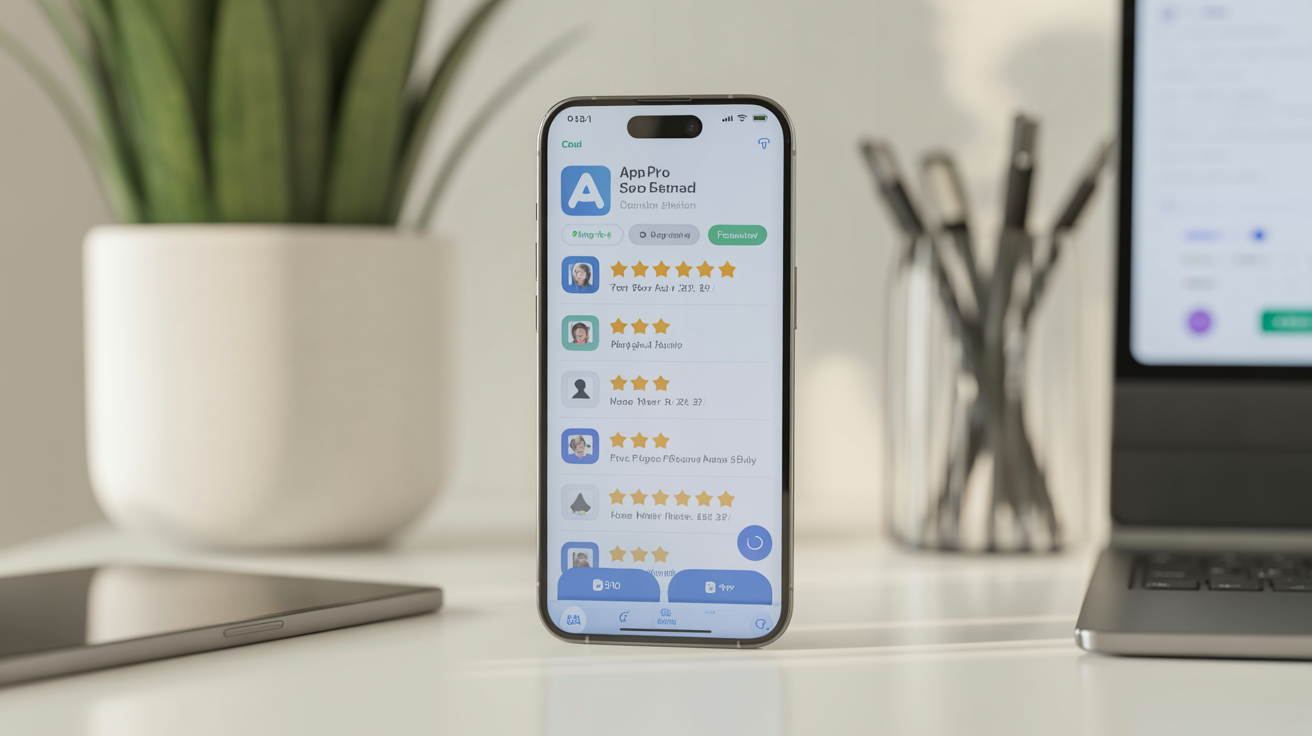
The market for purchased app reviews has professionalized significantly since 2020. Today, when you use a legitimate platform like BoostFollowers.io, you're not ordering anonymous fake accounts - you're getting ratings from real user profiles that actually interact with your app. This distinction separates credible services from the fabricated reviews of the past, which Apple and Google have actively combated for years.
What distinguishes good providers from poor ones
When buying App Store reviews, look for these markers of a legitimate provider:
- Real user profiles with review history - no freshly created accounts
- Gradual delivery over several days, not all reviews at once
- Customizable review text - no identical copy-paste ratings
- Geographic targeting capability (e.g., English-speaking users for English markets)
- Transparent pricing with no hidden fees
Platforms like BoostFollowers.io offer exactly these parameters - similar to how they handle other channels, like buying Google reviews for local businesses. The underlying logic remains consistent: quality and authenticity protect against detection and ensure lasting impact.
Pricing models overview
Costs vary based on the number of reviews, target platform, and quality tier. Typical packages in 2026 look like this:
- Starter packages: 5 to 10 reviews for app launch - entry-level pricing starting around $15 to $30
- Growth packages: 25 to 50 reviews - for apps already in the market wanting to stabilize ranking
- Premium packages: 100+ reviews with custom text, geographic targeting, and star mix - for competitive categories like gaming, finance, or health
Apple App Store vs. Google Play: differences in buying reviews
Both platforms actively combat manipulated reviews - but with different mechanisms. If you want to buy app reviews, you need to understand these distinctions.
Apple App Store
Apple relies on algorithmic detection of unnatural rating patterns. Sudden spikes (50 reviews in one day, then nothing) are a red flag. Apple can remove ratings or, in extreme cases, delist an app. The company is also known to moderate reviews more strictly than Google - especially when text appears generic or repetitive.
Google Play
Google employs machine learning models to identify fake reviews. Detection mechanisms here are particularly sophisticated: metadata from reviewers (device, timestamp, network) are evaluated. Google has repeatedly deleted large volumes of detected fake reviews in recent years - sometimes retroactively, which has sharply damaged rankings.
Legal aspects and compliance: what you need to know
Buying reviews exists in a legal gray zone you should understand. In the EU, since 2022, the revised Unfair Commercial Practices Directive explicitly classifies fake reviews as unfair - if they're disguised as genuine customer opinions.
The critical distinction:
- Paid reviews clearly identified as such - in many contexts legal
- Paid reviews disguised as organic user opinions - legally problematic and violates Apple and Google's terms of service
In practice: if you use legitimate providers and don't actively promote ratings as „authentic customer opinions," you operate in defensible territory. Still, have your legal counsel review this question for your specific market and app category. Extra caution is warranted in B2B or regulated app categories (fintech, health).
Organic ASO strategy as accompaniment: reviews alone aren't enough
Buying App Store reviews is a lever - not a replacement for solid ASO strategy. The best rating structure helps little if your title, keywords, and screenshots are poorly optimized. These elements belong in every complete ASO strategy:
- Keyword optimization in app title and subtitle - especially important for Apple App Store
- Compelling screenshots and preview videos that immediately communicate core functionality
- Regular updates that Apple and Google value as activity signals
- Actively responding to existing user reviews - including negative ones
- In-app prompts encouraging satisfied users to rate (Apple allows up to 3 prompts per year)
Purchased reviews work best as an accelerant: they push your app into a visible rating zone that then attracts organic interest. Once real users stream in and rate positively themselves, the initial purchase becomes an investment, not permanent dependency. The principle mirrors what we see in social media - like strategically using purchased followers as a growth accelerator.
How to use App Store reviews safely and effectively
If you want to buy app reviews without risking your account, follow a clear process. Here's a proven approach for 2026:
- Establish baseline: determine how many reviews your direct competitors have in the category. That's your minimum goal for phase 1.
- Vet providers: use only platforms emphasizing real profiles and making no guarantees that sound too good (e.g., „10,000 reviews in 24 hours").
- Set up monitoring: track progress weekly with tools like AppFollow or Sensor Tower. If ratings unexpectedly disappear, adjust your provider.
Order App Store reviews most effectively as part of a broader plan - not an isolated action, but synchronized with an app update, press moment, or social media campaign.
Take your social presence to the next level
Likes, views, followers, reviews: pick the service that matches your goal. Instant start, secure payment, satisfied or refilled.
Frequently asked questions
Is it legal to buy App Store reviews?
Buying reviews violates Apple and Google's terms of service and exists in a legal gray zone in many EU countries. Legitimate providers use real user profiles and natural delivery patterns to minimize risk. Still, you should individually review the legal situation for your category and market.
How many reviews do I need to improve my app ranking?
This depends heavily on category. In competitive segments like gaming or productivity, you often need 50 to 100 reviews to appear on first pages. In niche categories, 20 to 30 quality reviews can produce measurable ranking effects.
Does Apple or Google automatically detect bought reviews?
Both platforms use algorithmic detection systems identifying patterns like unnatural rating spikes, identical text, or new accounts without review history. Quality providers circumvent these filters through staggered delivery, real profiles, and personalized text - but complete protection against detection doesn't exist.
Can I buy reviews only for Apple App Store or also for Google Play?
Both are possible. Good providers distinguish between the two stores and use platform-specific delivery protocols, since Apple and Google employ different detection mechanisms. Ideally order separately for each platform and stagger delivery independently.
How long until purchased reviews appear in the store?
On Apple, reviews typically appear within 24 to 72 hours after App Store moderation approval. Google Play approval is often faster, but ratings undergo automated review here too. Expect 3 to 7 days total for a complete package to appear.
Next steps: build visibility, secure downloads
The path from an invisible app to a well-listed one begins with a solid review foundation. Buying App Store reviews is an established practice among professional app publishers in 2026 - provided it's implemented with proper care. Using real profiles, staggered delivery, and a natural star mix minimizes detection risk significantly.
Combine review purchases with solid ASO strategy: optimized metadata, compelling screenshots, regular updates. Purchased reviews create the stage - your product must then convince users who arrive. That's the only way to turn an initial boost into genuine, sustainable growth.
Start with a realistic package matching your category, monitor progress weekly, and scale based on results. Those who approach this systematically typically see measurable improvements in app store ranking - and thus download numbers - within four to eight weeks.
Julie Faure
Senior Writer — Social Media
✍️ Professional writer. Web content, SEO & brand content. Specialized in social media & digital marketing.
Julie supports creators, brands and entrepreneurs on their social media strategies and online visibility. She shares hands-on, field-tested advice here to help you understand algorithms, create content that genuinely engages, and turn social presence into a real business growth lever.
Related services
Buy Google Reviews French or International
Build a 5-star reputation on Google that reassures local prospects and converts fence-sitters into customers.
Buy Instagram Video Views
Boost your Instagram video view count and signal the algorithm that your content deserves to be promoted.
Buy Instagram Followers
Accelerate your Instagram profile growth with followers delivered naturally to establish credibility at first glance.
Related reads

Buy Google Play reviews in August 2026
Buying Google Play reviews is a concrete strategy to improve your Android app's ranking and convince users before download. Discover how to do it effectively in August 2026.
Buy Google Reviews: The Solution to Combat Negative or Missing Google Reviews
In a world where online reputation is crucial, buying Google reviews can transform how your business is perceived. These reviews influence potential customers' decisions. By investing in positive reviews, you strengthen your company's credibility and improve your online visibility. What advantages can you gain from this bold strategy?

How to analyze your Telegram channel performance: complete guide
View rates, subscriber growth, share rates, reactions... Knowing how to analyze your Telegram performance is essential to refine your strategy and grow your community. This guide covers key KPIs, native platform statistics, best editorial practices, and advanced monitoring approaches.
Analyzing Your Spotify Performance: A Complete Guide
Streams, monthly listeners, demographics, saves: Spotify for Artists is packed with essential data. This guide explains how to read each metric, identify your growth levers, and make informed decisions for your music career.