LinkedIn Content Strategy: The Complete Guide
Define your goals, target your audience, choose the right formats, and publish consistently: this complete guide gives you everything you need to build a LinkedIn content strategy that generates real professional opportunities.

Contents 8 sections
- 1 Define clear goals before publishing anything
- 2 Identify your audience and build your ICP
- 3 Choose the right content formats for each funnel stage
- 4 Build an editorial calendar and publish consistently
- 5 Authenticity, storytelling, and editorial tone
- 6 Optimize your LinkedIn profile or company page
- 7 Measure, adjust, and improve your strategy
- 8 Frequently asked questions
A LinkedIn content strategy has become one of the most tangible levers in B2B marketing. Yet most companies and professionals publish without a clear direction: a few inspirational posts here, a video there, followed by three weeks of silence. The result: erratic reach, little engagement, and no tangible opportunities generated.
LinkedIn is neither Instagram nor TikTok. The network brings together decision-makers, recruiters, buyers, and industry experts who come looking for value, not entertainment. A well-crafted post can circulate within highly targeted professional circles and lead to demo requests, job applications, or partnerships. LinkedIn is regularly cited as one of the best-performing channels for B2B lead generation - provided you publish methodically.
This guide takes you through the process step by step: defining your goals, identifying your ideal audience, choosing the formats that perform, structuring an editorial calendar, and measuring what really matters. Every section is actionable - no empty theory, only methods you can apply this week.
Define clear goals before publishing anything
Publishing on LinkedIn without a defined goal is like sending résumés without reading the job listings. The first step in a solid LinkedIn content strategy is answering a simple question: what do you want to achieve?
The four main categories of LinkedIn goals
- Awareness: introduce your brand or expertise to an audience that does not know you yet.
- Lead generation: convert followers or readers into qualified contacts, subscribers, or warm prospects.
- Recruitment: attract candidates by showcasing your company culture and open positions.
- Industry authority: become the go-to source on a specific topic so that your name comes up naturally in conversations within your industry.
These goals are not mutually exclusive, but they do not call for the same types of content. A brand seeking awareness publishes trend analyses and points of view. A company looking to recruit focuses on behind-the-scenes content, employee testimonials, and values. Define one primary goal and one secondary goal - that is enough to frame your editorial direction.
Turn your goals into measurable indicators
An unmeasurable goal remains a wish. Match each major intention with a specific performance indicator: the number of incoming connection requests, click-through rate to a product page, number of applications through LinkedIn, or number of incoming messages related to a post. These metrics will be your compass as you adjust your content from week to week.
Once your goals are set, the next step is to identify whom you are really addressing - because publishing for “everyone” means speaking to no one.
Identify your audience and build your ICP
The Ideal Customer Profile (ICP) is the foundation of any effective LinkedIn content strategy. Without it, your posts miss their target and struggle to reach the right people.
How to define your ICP on LinkedIn
To build your ideal reader profile, combine the following data:
- Industry and company size (SMB, mid-market company, large corporation).
- Role and seniority level: decision-maker, operational manager, technical expert.
- Daily professional challenges: what friction slows down their work?
- Information sources: what types of posts do they already comment on LinkedIn?
- Career or performance goals: what motivates them to open their feed.
This is not a theoretical exercise. Spend thirty minutes analyzing the profiles of your best customers or most engaged contacts. Look at what they publish, what they comment on, and the hashtags they follow. These signals reveal their vocabulary, concerns, and the tone that resonates with them.
Message targeting and segmentation
If your audience is diverse - for example, CFOs and IT managers - consider segmenting your posts by day or format. A long-form article can address strategic decision-makers; a short post with technical advice will speak more directly to operational profiles. Editorial segmentation is an often-overlooked but effective lever for maintaining a consistent engagement rate over time.
With a clearly defined audience, you can choose the formats that suit it - and that is precisely what we will examine next.
Choose the right content formats for each funnel stage
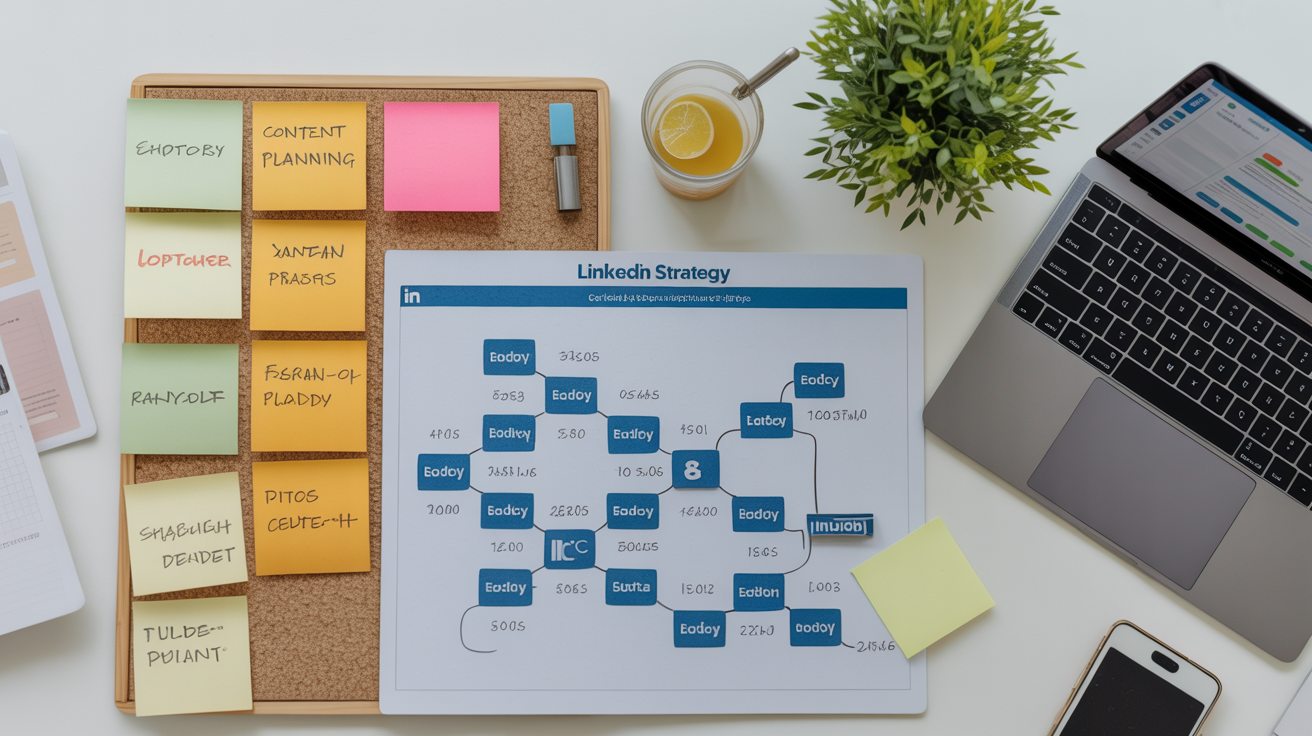
LinkedIn offers several native formats, and they are not equally effective at every stage of your audience's journey. Thinking in terms of the conversion funnel (TOFU - MOFU - BOFU) helps you distribute your efforts consistently.
TOFU: attract strangers with broad-reach content
At the top of the funnel, the goal is discovery. The formats that tend to generate the greatest organic reach on LinkedIn are:
- Short text posts (150-200 words) with a strong hook in the first line visible before “see more.”
- PDF carousels: a popular native format because it holds attention for several seconds and encourages swiping.
- Short videos published natively (not through a link to an external platform) - a duration of 60 to 90 seconds is often cited as accessible for this format.
- Polls: they generate quick interaction and qualitative data about your audience.
MOFU: nurture interest with valuable content
People who already follow you need more substantial content. At this stage, LinkedIn articles and native newsletters let you explore a topic in depth and demonstrate your expertise. LinkedIn allows active creators to publish newsletters directly on the platform: subscribers then receive automatic email and in-app notifications for each new issue. A well-structured article about a specific industry challenge can generate comments and incoming connection requests for several weeks after publication.
BOFU: convert with tangible proof
At the bottom of the funnel, your audience needs reassurance. Publish case studies, customer testimonials, quantified results, or short demonstrations of your product or service. This format generally generates less raw reach but more commercial traction: the people who read it are often close to making a decision.
Mixing these three levels in your editorial calendar - as a guideline, a majority of TOFU content, an intermediate volume of MOFU, and a smaller share of BOFU - helps maintain growth momentum while feeding your pipeline. Let us now see how to structure this pace over time.
Build an editorial calendar and publish consistently
Publishing consistency is a differentiating factor between LinkedIn accounts that grow and those that stagnate. Publishing consistently helps your network perceive you as an active and reliable presence on the platform.
What frequency should you adopt?
For a personal profile or company page that is just getting started, three to four posts per week is a sustained but manageable pace. Below one post per week, your network may no longer see you regularly in its feed. Conversely, a very high frequency can tire your audience - LinkedIn is not a network designed for publishing every hour. The balance between consistency and quality remains the most important criterion.
“Consistency on LinkedIn matters more than perfection. One solid post published every week for a year builds a far more lasting presence than ten brilliant posts published in one month, followed by abandonment.”
Structure of an effective LinkedIn editorial calendar
Organize your schedule on a rolling monthly basis with the following columns:
- Publication date and time (Tuesday and Thursday mornings between 8 and 10 a.m. are frequently cited slots for a French-speaking professional audience, although the best time always depends on your specific audience).
- Format (text, carousel, video, article, poll).
- Funnel stage (TOFU, MOFU, or BOFU).
- Main topic and angle (the angle is often more important than the topic itself).
- Call to action (comment, download, contact, share).
This simple framework lets you see the balance of formats and funnel stages at a glance. To broaden the reach of your best posts beyond your immediate network, extending the distribution of your LinkedIn posts through targeted shares is an option to explore - however, note that the LinkedIn Professional Community Policies prohibit any attempt to artificially increase engagement, and you should review them before taking any such action. Let us now move on to what turns a good post into memorable content.
Authenticity, storytelling, and editorial tone
LinkedIn long suffered from a reputation as a corporate network where everyone congratulates one another. The posts that perform today are those that tell something true, useful, or surprising.
Professional storytelling: an underused lever
Storytelling does not mean recounting your personal life. It means structuring an idea or professional experience as a narrative: a problem encountered, the actions taken, and the lesson learned. This approach follows the “situation - complication - resolution” logic that readers absorb naturally because it creates tension and resolution within a few paragraphs.
A post that begins with “I lost a major client six months ago. Here is what it taught me about account management” generally generates more engagement than a simple list of tips. Authenticity creates trust, and trust makes conversion easier.
Find your editorial tone
Your editorial tone should remain consistent from one post to the next. Define it using three adjectives (e.g., direct, educational, unfiltered) and check that every post you write aligns with them. An unstable voice - formal one moment, casual the next - blurs your image and weakens how well readers remember your profile.
Authenticity generates organic engagement. But even the best content needs a sufficiently large audience to shine. That is why optimizing your presence on the platform is a step you cannot skip.
Optimize your LinkedIn profile or company page
A well-optimized LinkedIn company page or polished personal profile acts like a landing page: it is the first place a reader visits after encountering one of your posts. If what they find there does not confirm the impression created by your content, you lose most of the opportunities generated.
Priority optimization elements
- Profile photo and banner: professional and consistent with your positioning. The banner is free visual space that is often left empty.
- Headline: do not settle for your job title. Express the value you provide (e.g., “I help industrial SMBs reduce their logistics costs”).
- Summary (About): write it in the first person, in two or three paragraphs answering “who you are, what you do, and why the reader should contact you.”
- Featured section: add your best post, a link to your website, or a downloadable lead magnet.
- Recommendations and skills: they provide trust signals for visitors discovering you.
Regular audit of your LinkedIn presence
Audit your profile or page every quarter. Check that the information is up to date, pinned posts remain relevant, and your audience statistics are moving in the right direction. For company pages, LinkedIn natively provides analytics on reach, impressions, and follower demographics, available from your page's administrator dashboard.
A credible, complete page amplifies the effect of every post. To accelerate this credibility-building process, strengthening the follower base of your LinkedIn page is an option some consider to display a more established presence - however, it is important to consult the LinkedIn Professional Community Policies before taking any action, as the platform explicitly prohibits practices intended to artificially increase engagement or followers. The final dimension to master is measurement: without rigorous analysis, you are flying blind.
Measure, adjust, and improve your strategy
A LinkedIn content strategy is not built once and for all. It is continuously refined based on platform feedback and your audience's behavior. Without a regular analysis process, you risk repeating what does not work and abandoning what does.
The metrics that really matter
Distinguish vanity metrics (number of raw views) from impact metrics:
- Engagement rate (reactions + comments + shares divided by impressions): indicates whether your content truly resonates. LinkedIn defines impressions as the number of times a post is visible for at least 300 milliseconds with at least 50% of the post displayed on a signed-in member's screen.
- Qualitative comments: their nature reveals whether you are reaching the right audience with the right message.
- Net follower growth over the analyzed period: a sign that your content attracts new, relevant profiles.
- Clicks to external links (to your website, landing page, or newsletter): the metric most directly related to your ROI.
- Off-LinkedIn conversion rate: how many leads, registrations, or contact requests come from the network?
The monthly analysis routine
Set aside one hour at the end of each month to analyze your most recent posts. Identify the two or three that performed best and ask yourself these questions: what format? What angle? What length? What call to action? Then identify the poorest performers and look for what sets them apart from the best ones. The first interactions after a post goes live can influence its distribution - which is why refining the hook and encouraging colleagues or partners to react quickly remains a good organic practice. For high-potential posts, generating reactions on your LinkedIn posts is an option some users explore to amplify their initial visibility - first consult the LinkedIn Professional Community Policies, which strictly regulate every form of artificial engagement. To explore growth mechanics on other networks and broaden your cross-platform perspective, read our guide to proven strategies for growing your presence on Facebook.
Analysis turns your editorial calendar into a continuous learning system. Over time, each iteration brings you closer to an editorial formula that produces predictable results - the true goal of a mature content strategy.
Ready to boost your presence?
Place your order in 2 minutes, drip-feed delivery, credible profiles, retention guarantee.
Frequently asked questions
What is the ideal length of a LinkedIn post for maximizing reach?
Posts between 150 and 300 words tend to generate good engagement rates on LinkedIn. Posts that are too short may lack enough substance to hold attention, while very long texts cause some readers to leave before the end. The first line is crucial: it should encourage readers to click “see more” naturally and relevantly.
How often should a company page post on LinkedIn?
For a company page, three to five posts per week is often cited as a balanced pace between visibility and quality. Long-term consistency matters more than raw short-term frequency: it is better to publish three times a week for six months than ten times a week for three weeks and then stop. LinkedIn does not publish a single official recommendation for the ideal frequency - the right pace depends on your resources and content quality.
Are LinkedIn articles still worthwhile compared with short posts?
LinkedIn articles generally generate less immediate organic reach than short posts, but they build your authority over the long term. They appear on your profile and can be indexed by search engines - LinkedIn also allows you to add an SEO title and SEO description to each article to optimize its visibility in external search results. Use them to explore complex topics that short posts cannot properly cover, and combine them with a teaser post to maximize their initial visibility.
How can you increase the reach of LinkedIn posts without an advertising budget?
Several organic levers can extend reach without investing in advertising: respond quickly to every comment after publication, sparingly mention people who are genuinely concerned by the content, use two to four relevant hashtags rather than ten, and encourage colleagues or partners to interact with your posts as soon as they are published. The quality of the hook remains the most decisive factor in encouraging people to read.
Should you post in French or English on LinkedIn?
The answer depends entirely on your target audience. If your customers and partners are mainly French-speaking, publish in French - you will achieve a higher engagement rate because your audience feels directly addressed. If you are targeting an international audience or specific English-speaking markets, English is the natural choice. Some professionals alternate between both languages, but this can dilute the perceived consistency of their editorial direction.
Julie Faure
Senior Writer — Social Media
✍️ Professional writer. Web content, SEO & brand content. Specialized in social media & digital marketing.
Julie supports creators, brands and entrepreneurs on their social media strategies and online visibility. She shares hands-on, field-tested advice here to help you understand algorithms, create content that genuinely engages, and turn social presence into a real business growth lever.
Related services
Buy LinkedIn Likes
Position your LinkedIn posts as industry references with likes that multiply their reach across your network.
Buy LinkedIn Connections for Your Profile
Expand your LinkedIn network with relevant connections that broaden your reach and strengthen your professional credibility.
Buy LinkedIn followers for your business page or personal profile
Turn your LinkedIn page into a credible professional showcase with followers who amplify the reach of every post.
Related reads

Buy LinkedIn Reposts: Expand Your Reach in August 2026
Want your LinkedIn content to reach more professionals? This guide explains how to buy LinkedIn reposts effectively, timing strategies, and tips to maximize ROI in August 2026.

Discord Community Strategy: How to Engage and Retain Members
Building an active Discord community requires more than good intentions. Learn how to structure your server, plan content strategically, manage roles effectively, and keep members engaged long-term with a proven community strategy framework.

How to grow your SoundCloud audience: complete guide
Learn how to grow your SoundCloud audience with proven strategies: optimize your profile, publish consistently, use tags and metadata, build community engagement, collaborate with artists, and leverage SoundCloud's official promotion tools for independent musicians.

How to analyze your Twitch performance effectively
Understanding your Twitch statistics is the foundation of serious growth. Learn how to read key metrics, interpret your creator dashboard, and make concrete decisions to develop your channel.